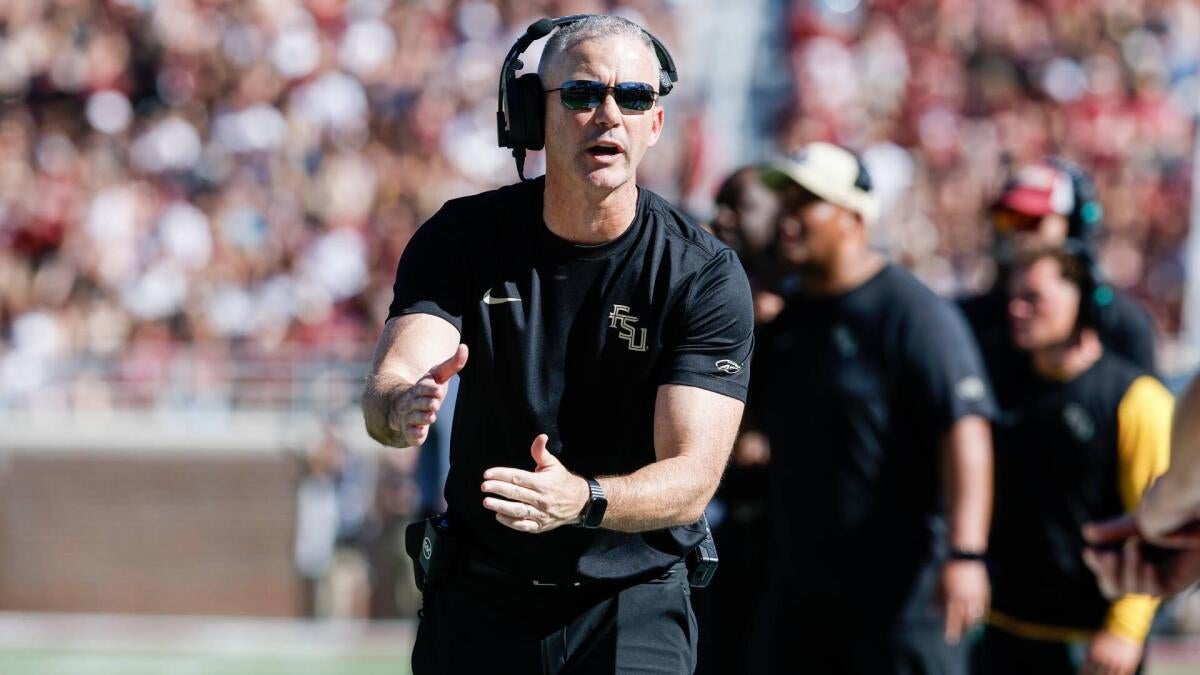
Buyout clauses are the most critical financial line item in a college football coach's contract, often determining how easily a school can part ways or how long a coach's financial specter lingers on the balance sheet. Headline-grabbing figures dominate the SEC, where Jimbo Fisher's fully guaranteed $76.8 million buyout from Texas A&M set a record, making Gus Malzahn's $21.4 million from Auburn seem modest. Former LSU coach Ed Orgeron recalled being told he had $17.1 million remaining on his contract and responding, "What time do you want me to leave and what door do you want me out of, brother?"
At the lower-paid levels of the sport, the calculus is starkly different. Sam Houston State, one of the newest FBS programs, fired offensive coordinator Phil Longo in late October. Longo's 2025 salary was $725,000 ($700,000 base plus $25,000 supplemental), comparable to some SEC position coaches. His five-year contract carried a maximum of $950,000 with all incentives. He is owed the remainder of his 2026 salary plus base salaries for 2027 and 2028 — roughly $1.53 million total — plus $50,000 in supplemental income, paid monthly through the deal's end. That sum pales next to Mike Norvell's approximately $50 million buyout at Florida State, but it illustrates the financial mechanics at the Group of Six level.
The Mitigation Clause
The real number in any buyout often hides in the fine print: the mitigation clause. Longo's contract states that if he receives compensation from another coaching position while collecting buyout payments, Sam Houston may reduce those payments dollar-for-dollar by the amount of his new earnings. He must promptly report any new coaching employment to the athletic director. Without mutual written agreement, the university will not reassign him to another role in lieu of termination. In practice, if Longo lands a Power Four coordinator job paying more than his remaining buyout, the school owes him nothing. Offset clauses are now boilerplate to avoid situations like Texas A&M's, and many contracts include a duty-to-mitigate clause requiring coaches to seek work in good faith — a reason coaches on the shelf often interview for jobs even if they don't get them.
Schools Guard Against Offset Gaming
Industry sources describe the school as the bank: "You need to be nice to the bank so you can withdraw money out right over the course of your contract." Schools have sharpened language to prevent coaches from structuring new deals to game the offset. For example, a coach owed one year of buyout money cannot have a new employer pay $500,000 in year one and $1.5 million in year two to average $1 million while defraying the old school's cost. Group of Six schools "nickel and dime you on everything" and demand contracts from the new employer to cross every T and dot every I. In extreme cases, a school has requested a coach's tax returns to verify income.
Financial Pressures at Group of Six Schools
The decision to fire a coach extends beyond wins and losses. Athletic directors weigh political capital and overall budgets. Some opt to invest more in the roster instead: Wyoming head coach Jay Sawvel donated $125,000 to the Cowboys' NIL and roster budget, mirroring Norvell's $4.5 million commitment at Florida State in 2024. Revenue generation is paramount. Akron sold out its suite inventory for the first time in school history and beat ticket sales goals before the 2026 season, using a raffle for the opening offensive drive to incentivize referrals. The median Group of Six athletic department budget is around $44 million; Sam Houston's expenses in fiscal year 2025 were $42 million. Without the tens of millions in television revenue that Power Four schools enjoy, ticket sales become a critical revenue stream.
Ticket Revenue as a Deciding Factor
Athletic administration consultant KC Smurthwaite says ticket data is one of the first things he examines when a school considers a coaching change. Some Group of Six schools expect $300,000 to $500,000 per game in single-game ticket purchases. Even at a conservative $150,000 to $225,000 per game, fan apathy over a struggling coach can cost $500,000 to $600,000 over three or four remaining home games. Season-ticket holders spend an average of $21 on concessions, parking, and other extras. When longtime ticket buyers like "Billy and Sally" stop attending the last two home games, qualitative analysis often reveals dissatisfaction with the program. If a $1.5 million buyout is offset by losing $100,000 per week in empty seats — with no guarantee of improvement next season — an athletic director may fire the coach, hope mitigation reduces the payout, and attempt to recoup lost revenue.
"Can we actually just make that money back with the opportunity cost to hey, we're actually losing more money by being patient, and we're going to make a change," Smurthwaite said. The coaching carousel spins at every level, but the ride is expensive whether in College Station or Huntsville — the cost is all relative.


